
Welcome back everyone! It’s been a while and a lot has changed at the Lee District Schoolhouse. We’re excited to share our long overdue updates about the renovation and the history we’ve uncovered.

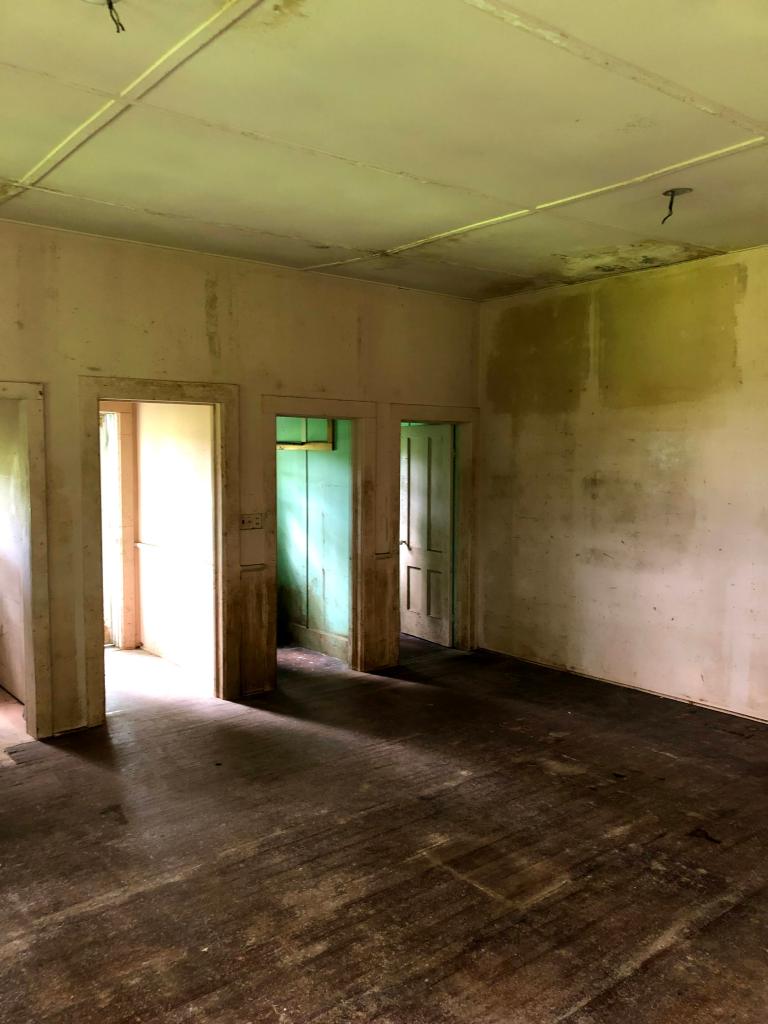
Right at the beginning we started to slowly peel away what we could on the interior. Our goal was to preserve what we could, salvage what was still viable and discard what couldn’t be saved. After years of weathering the elements, without being properly sealed, it was not possible to save any of the drywall or plaster except the vestibule; the only room with walls not directly against the exterior. The plaster elsewhere was cracked, water stained and barely hanging on the structure. This meant several weekends of work removing drywall, taking down trim and the most time-consuming part of the demolition, taking down all the plaster and lath board. We both agreed that we needed to take our time, which was the right decision in the end, but it was exhausting work. Once we started taking down the drywall on the roadside wall, we found rolled up bits of newspaper shoved behind the drywall as shims and shoved in a few cracks. There were several whole pages that ended up being well preserved, helping us date when the drywall was installed.

This was the first time that the plaster had seen the light of day in well over half a century! Ghost outlines of a chalkboard and other wall mounted fixtures were discovered underneath the drywall. The plaster that was left on this wall would easily crumble at the touch of a finger. Removal of the drywall also revealed original wainscoting along the entire wall that we needed to remove and set aside for reinstallation. In the end we were able to save the majority of the wainscoting, give or take a few corner panels.

On our third weekend of demolition, we discovered our first major piece of schoolhouse history! Hidden behind the wainscoting we found a name and a year etched into the plaster. Just like the many children that spent their years in the schoolhouse, a builder, William L. Town, wanted to leave a signature for later generations to find.

William L. Town was born in 1864, the son of another local carpenter. After peeling back layers of the schoolhouse, it appears that in the 1888 renovation of the pre-1850 schoolhouse included some modifications to the floor plan by adding dividing walls, re-lathing and plastering the entire interior. It also included updating the trim around the doors and windows, and the wainscoting which gave William Town the perfect opportunity to leave his mark, concealed in the building. William was only 24 years old when he completed this work. He remained in Granville NY, growing his business for the remainder of his life. After taking the interior walls down to the studs, we made sure to affix stabilizers around the plaster signature to preserve it for another 144 years.

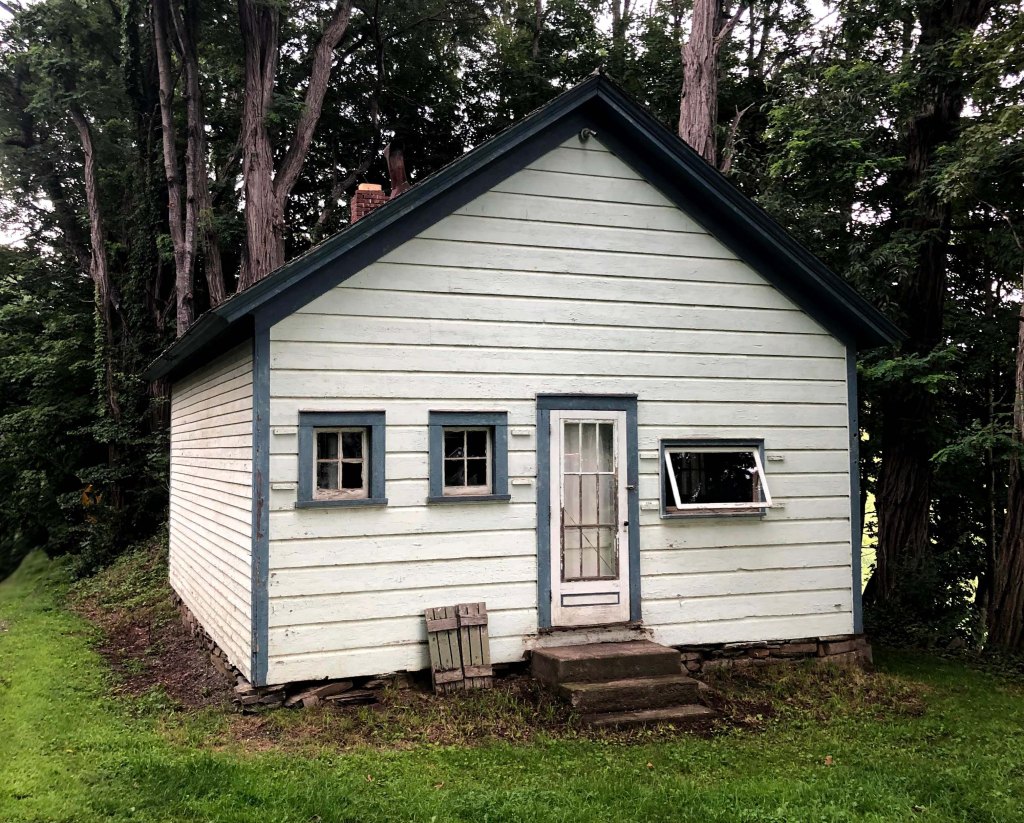
Once we pulled the lath boards off we discovered yet another surprise! Behind everything we removed from the walls, we discovered the original window framing. When the schoolhouse was originally constructed, there were two windows on the road side, two windows on the chimney wall, and two windows on the pasture side walls(this can be seen in a picture of the schoolhouse from 1915). As best as we’ve been able to determine, the windows were moved from the street side and installed on the pasture side wall after William Town re-plastered. Though it’s unclear when the windows were relocated to the adjacent wall, it was done much later as the infill plaster used was a concrete mix which was much thicker and tougher than the surrounding plaster. The change was most likely done to increase natural light inside the building as all the windows were moved to the east wall and raised in height to capture more sunlight.

On the North side of the main room, we were finding an unusual amount of rubble in the walls. Plaster, mortar and burned brick. It was surprising as the chimney is fully intact, with no apparent damage or missing pieces. Also, some of the bricks were coated with creosote. After looking up to the roof and down to the floor, we discovered these were the remnants of the original interior chimney. At some point, the original brick chimney inside the schoolhouse extended from the floor up through the roof and was entirely inside of the building. Base on the wall patching materials, the chimney was rebuilt outside around the same time the windows were moved to the opposite wall!


The entire demolition process took us a few months, which brought us to the beginning of winter. Since insulation was never installed over the years, and it no longer had additional material on the walls or ceiling, it quickly became too cold for us to work effectively in the New England winter.
We’re excited to share the progress that came in the spring, and the continued discoveries we make about this building and its history at every step along the way!

 Lee Schoolhouse